
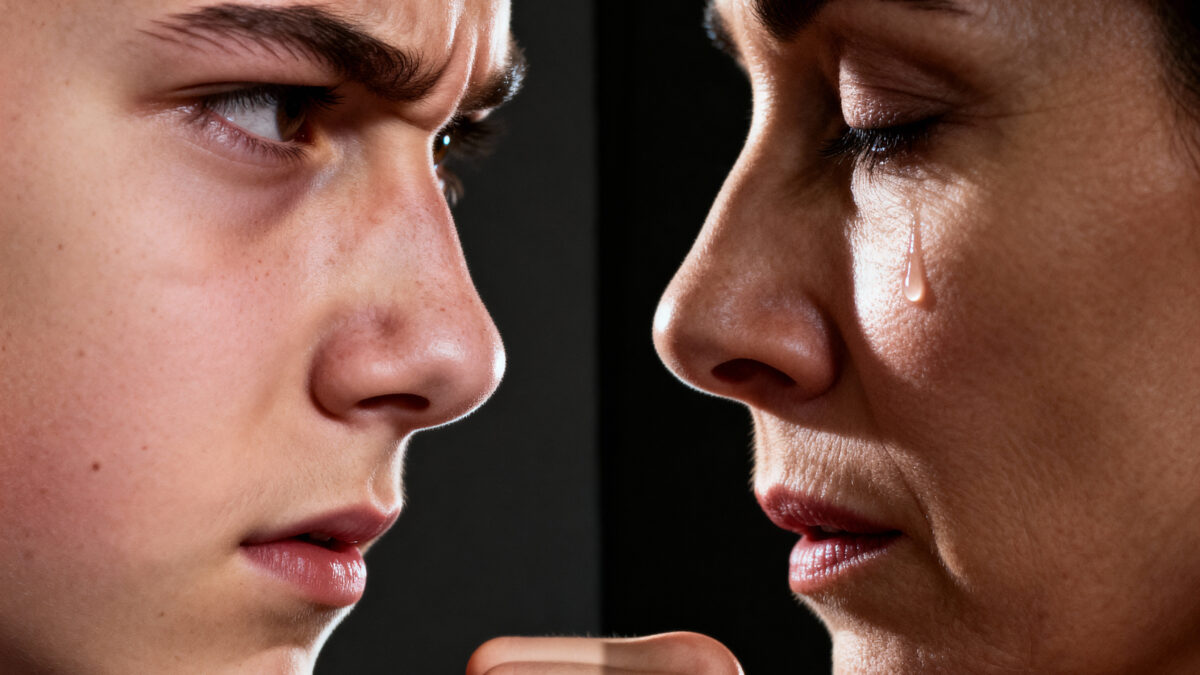
We Talk About Domestic Violence. But Do We See the Child in the Middle?
We talked about domestic violence. We understand the systematic way a spouse is broken down: morally, psychologically, spiritually, and physically. We recognize the difficulty in leaving, the legal frustrations, and the shelters.
We’ve watched courts be fooled by narcissistic, wealthy men who charm their way out of allegations, maintaining access to their children and continuing to impact the mother’s life.
But have we ever *truly* understood the effect on the child?
Domestic violence is a taught behavior. It doesn’t come from nowhere.
We know a son who sees his father’s behavior has a choice to make. He saw it; he wasn’t directly taught it. But what happens when the father *directly teaches* the child to treat the mother the same way?
That creates a whole new level of domestic violence. It’s no longer partner-to-partner. It becomes child-to-parent.
This isn’t elder abuse—that comes much later. This is what happens in between.
Let me tell you a story.
A mother separates from her narcissistic, abusive husband. They have a son on the spectrum. The father, understanding he can mentally manipulate the boy, turns him against his mother.
He gets unsupervised visitation. In the darkness, he teaches this child what to say, how to act, how to treat his mother in her own home. Behaviors that aren’t permitted in his.
Because of the love this child has for his mother, he struggles. But the behavior spills out. Every woman in his mother’s world becomes a target. Then, every woman at his school. His IEP now lists “Emotional Disturbance.”
ACS gets involved. The father cons the worker on his side. The mother is cleared. However, she can’t get the help she needs to protect her child from the mental abuse he’s receiving.
This has been going on for seven years.
For seven years, the father deliberately teaches his son to be mentally, vocally, and physically abusive towards his mother.
Then, an accident. The mother is injured, and the father has extended visitation for two weeks. The son, not realizing the lesson was intended for his mother alone, directs abusive behavior toward every woman his father introduces. He does the same to his brother’s girlfriend and his father’s girlfriend.
The father no longer finds it cute.
For two weeks, it’s chaos. When it’s time to go home, the child has a question, a Damascus Road moment:
“If I couldn’t do it with you, why are you now telling me to do it to my mother?”
The child saw the hypocrisy. He stopped talking to his father.
But the problem? Those taught lessons were still inside him. He was 14. For seven formative years, he was taught to abuse his mother to get his way, to show dominance.
The mother and son made a pact. She would help him, clean up his educational record, and see him through everything. But there was one rule: He was not to lay hands on her again.
For four years, they rebuilt.
Then, recently, something shifted. New frustrations arose. That voice in the back of his mind, from the past, has awakened. The one his father planted, spoke up: “This is how you shut her down.”
He’s on the spectrum, but that’s no excuse. He’s high-functioning. He knew what he was doing.
He violated the one rule. He touched his mother. He figured out a way to pin her down. To show dominance over her without saying, “I can hurt you before you can hurt me.” And he injured her.
She’s not pressing charges. She’s not putting him out. But the mother he had for the last four years, He silenced her. She will see him through school, but her walk and her dealings with him have changed forever.
So I have a question for all of us:
When are we going to do more to fight domestic violence?
We might protect the mothers sometimes. But do we really protect the children to stop the cycle?
Children face two possible paths: they either learn to love in a healthy way, or we abandon the girl who thinks love means being hurt and the boy who believes hurting is love. It comes down to whether we help them relearn love or leave them trapped in the cycle of abuse. And sometimes, that first abuse is directed at his own mother. Most mothers don’t speak up until it’s called elder abuse, and by then, it’s too late.
We’re heading into winter. Domestic violence rises when it gets cold, when people are forced indoors. It’s not just partner-on-partner. It’s children on parents.
The behavior is learned. But we never look at all the parties involved.
And it’s time that we do.
Our children need just as much care and therapy at a young age to correct what they’ve witnessed. Not just be shuffled into a system, which just adds more trauma. Leaving a mother to struggle alone after she’s gotten the courage to leave doesn’t help the child; it just breeds more resentment.
As a society, especially one as rich as ours, our track record for caring for our own is poor.
We must do better.
The worst season for domestic violence is here. Let’s stay alert. Too many people will be suffering, and it might not be from whom we expect.
Because too many are afraid to speak out against those they love.
Thiz is Me, Cee Marie
#DomesticViolence #StopTheCycle #ChildAbuse #MentalHealth #BelieveSurvivors #DoBetter